Safe rooms and panic rooms in Florence and Tuscany
NetCom Security Group
Safe rooms and panic rooms in Florence and Tuscany: villas, stone farmhouses and historic residences in Chianti, Versilia and Lucca. Installed by our own technicians.
For the full picture, see safe rooms and panic rooms.
Safe rooms and panic rooms in Florence and Tuscany: NetCom Security Group designs and builds, with its own technicians, the secure room of the house, in villas, farmhouses and historic residences in Florence, Chianti, Lucca, Versilia, the Val d'Orcia and the Maremma.
A safe room, also called a panic room, is the room where the family locks itself in and stays protected, with communications active, until help arrives. In an isolated farmhouse one more armoured door is not enough: what is needed is a system of envelope, access, air, light and procedures designed around the people who live there and the real time it takes for help to arrive. In Tuscany we build it mostly in isolated houses in the hills and in renovations of stone farmhouses.
Request a confidential site visit
In brief
Where it is done in Tuscany
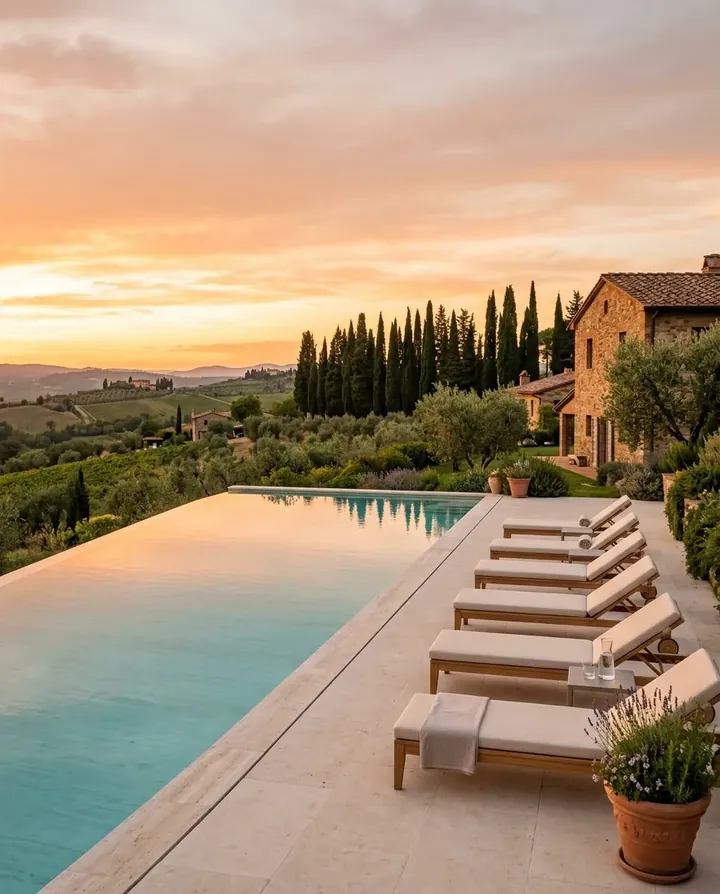
Stone farmhouses: what changes
The Tuscan farmhouse has stone walls sixty or even eighty centimetres thick. It is an excellent starting point: a ground-floor room with a single opening is already halfway there. Three things, however, must be checked.
Continuity: a thick wall is of little use if the ceiling is a timber floor with a bedroom above; the envelope is completed from the inside, with protective panels, without touching the exposed beams. The window: the openings are small, but old iron grilles are climbed over in a minute today; they are complemented by a protected internal closure. Damp: stone and earth banked against the walls bring water inside; air, electronics and door must be protected with designed ventilation.
In renovations everything is integrated into the works; in lived-in houses we work room by room, with our own technicians.

A house lived in only part of the year
Many owners in Tuscany live abroad and return for a few weeks, or entrust the villa to a caretaker and the household staff. Those who stay in the house must know how to use it; those who are far away must be able to see. We connect the room to the alarm, the cameras and a private app for the owner, and hand over procedures in Italian, English and German, to be rehearsed with the staff before departure. During the months of absence the system stays connected to selected external monitoring centres.
How we design it
- Confidential site visit. We look at the house, who lives in it and when, the routes and the time it takes for help to arrive.
- Scenario analysis. Intrusion with people at home, home robbery, emergency situations: for each one we decide where to lock in and for how long.
- Design of the room. Position, size, continuous envelope (walls, ceiling, floor), door and lock, air, light, backup power, independent communications.
- Integration with the system. Alarm, cameras, access control and home automation talk to the room: whoever is inside sees and communicates, whoever is outside does not get in.
- Installation and testing. Our technicians carry out the installation; at the end we test everything together with the people who will use the room and hand over the written procedures.
What makes a room secure
Safe room, strongroom, bunker
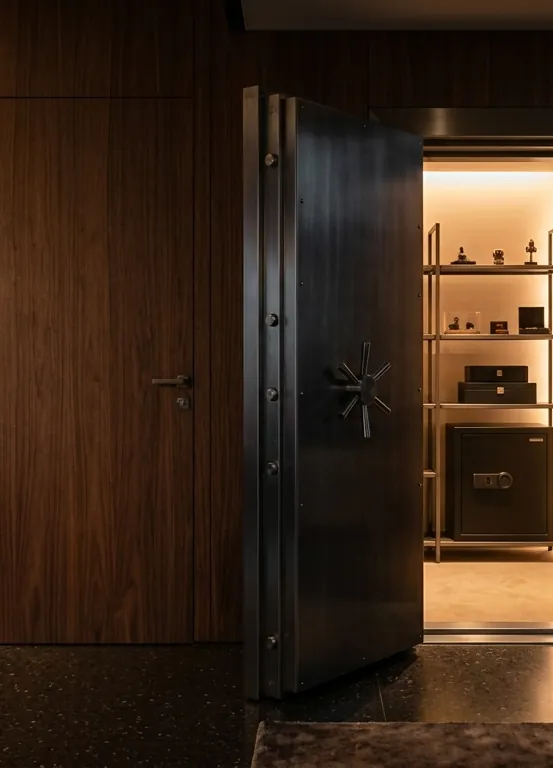
They are three different things. A safe room protects people for minutes or hours. A strongroom or vault protects valuables, resisting break-in for a long time. A bunker or shelter is for external events, for days, with filtered air. The needs can be combined in a single project: we decide after the site visit. For an overview read safe rooms and panic rooms.
Confidentiality
We sign a non-disclosure agreement before receiving floor plans or documents. We ask only for the data needed for the project. Our clients' homes remain confidential, even after the works.
Where we work
We follow projects in Florence and throughout Tuscany, all over Italy and, by project, in Europe. Our office is in Negrar di Valpolicella (Verona): for Tuscany we arrange the site visit within a few days. The other areas: where we work in Italy.
Frequently asked questions
How much does a panic room cost in Tuscany?
In Tuscany the cost of a panic room, in the experience of NetCom Security Group, depends on the size of the room, the level of protection of the envelope and the door, the air, light and communication systems and the building works needed in the house: in a stone farmhouse the building part can weigh less. After the site visit NetCom prepares a written bespoke proposal.
Is a safe room tax-deductible in Italy?
In part it can be: anti-theft works, such as armoured doors and reinforcements, are among the measures admitted by the Italian Revenue Agency. For expenses in 2026 the deduction is 50% for the owner's main home and 36% in other cases, up to 96,000 euros per property, in ten annual instalments. The specific case must be checked with an accountant.
Can a safe room be built in a villa listed by the heritage authority?
Yes: NetCom builds the envelope inside the room, reversibly, without touching frescoes, wooden ceilings and original floors. The permits are prepared with the professionals in charge of the restoration.
I live abroad and the villa has a caretaker: does a panic room make sense?
Yes, perhaps more than elsewhere: the room protects those who live in the house all year round, and the distant owner sees the cameras and the state of the system from the app. We rehearse the procedures with the staff before departure.
Who does the work?
Our own technicians: NetCom designs, supplies, installs, connects to the system and tests. Structural works are signed off by licensed professionals.
Are the thick walls of a farmhouse enough on their own?
They help a great deal, but they are not enough: the weakest point decides for all of them, and it is often the ceiling or the window. NetCom checks the whole envelope and completes only what is missing.
See also
Text by NetCom Security Group. Last updated: 23 October 2026.
Let's talk about your project
Tell us where the property is and what you want to protect: we will get back to you to arrange the site visit. You can also call +39 045 245 7879.