In brief. The food supplies in a shelter should be foods that keep at room temperature, can be eaten with little or no cooking, need little water and are liked by the people who will have to eat them. European authorities ask for at least 72 hours of self-sufficiency, Switzerland and Sweden for a week; a private shelter is sized on the number of days set in the design. The rule that keeps the supply alive is simple: consume and replace regularly.
How much to keep: the benchmarks in Europe and the United States
On 26 March 2025 the European Commission presented its Preparedness Union Strategy, which urges citizens to keep essential supplies for at least 72 hours. Some countries have long asked for more. The Swiss Federal Office for National Economic Supply recommends a supply for about a week and explains why: an interruption of supplies should not last months, but it can last several days. In Sweden the civil defence agency, on its page revised in September 2026, speaks of a week without having to go shopping. In the United States, Ready.gov, the FEMA website, remains more general and recommends a supply for several days.
| Source | Recommended period |
|---|---|
| European Commission (2025) | At least 72 hours |
| Switzerland, national economic supply | About one week |
| Sweden, civil defence and Krisinformation (2026) | At least one week |
| United States, Ready.gov | Several days |
These recommendations are meant for an ordinary home. In a shelter the time horizon is set by the design, based on the family's real needs and not on the maximum imaginable. Starting from real needs helps here too: a well-managed two-week supply is more useful than a three-month one forgotten on a shelf.
What to keep: criteria before the list
Official lists resemble one another, but criteria are more useful than lists. Krisinformation, the Swedish public portal, names five: foods that provide enough energy, cook quickly, need little water, can be eaten without cooking and keep at room temperature. Switzerland offers a concrete list: rice, pasta, oil, ready meals, salt, sugar, coffee, tea, dried fruit, muesli, rusks, chocolate, UHT milk, hard cheese, dried meat and tinned food. The Swedish list adds pulses, nut butters, nuts and seeds, honey and baby food.
Ready.gov points out two details that are often forgotten: the special diets of those who will live in the shelter, from allergies to the needs of young children, and a manual tin opener. The latter seems trivial until you find yourself facing twenty tins and an electric opener with no power.
The typical mistake: forgetting the water
Rice and pasta keep for a long time, but cooking them requires water and a source of heat. In a shelter both are limited resources. A supply built only on dry foods that need cooking shifts the problem onto the water reserve, which is sized for drinking and hygiene. That is why it makes sense to strike a balance: some ready-to-eat foods, eaten straight from the pack, and some foods to cook, for the days when conditions allow it.
Cooking in an enclosed room: when it is better to do without
For cooking without electricity, the Swedish agency suggests spirit or camping stoves, on a flat, non-flammable surface, in a well-ventilated room, and notes that it is easier outdoors. In a sealed shelter the reasoning changes. Every flame consumes oxygen and, if combustion is incomplete, produces carbon monoxide, a gas that the Istituto superiore di sanità (Italian National Institute of Health) considers dangerous indoors. Any cooking appliance must therefore be planned by the ventilation designer, not added afterwards. Without this check, it is better to favour foods that need no cooking. The subject is covered on the page about air, ventilation and filtration in shelters.
Storing and rotating: how the supply stays useful
The Food Safety and Inspection Service of the US Department of Agriculture gives precise guidance on tinned food. Low-acid canned goods, such as meat, soups, pulses and vegetables, keep their quality for two to five years; high-acid ones, such as tomatoes, most fruit and pickles, for 12 to 18 months. The ideal storage temperature is below about 29 °C; above about 38 °C heat damages canned goods. The same agency advises against damp cellars and garages and says to discard tins that are swollen, heavily rusted or deeply dented, particularly along the seams.
For an underground room, humidity is therefore a food issue as well as a structural one. A shelter with well-designed ventilation and humidity control protects the people and, by extension, what they will eat.
On dates, it is worth remembering the European distinction. According to the Commission, the "use by" label concerns safety, while "best before" concerns quality. In a supply the first must be strictly respected; the second indicates when a product starts to lose its characteristics.
Switzerland sums up management in one principle: integrate the supply into everyday cooking, consuming regularly and buying again. For a shelter separate from the house this is harder, because nobody passes through it every day. The method we propose is practical:
- label every pack with the date of purchase and place the oldest at the front;
- schedule two checks a year, on known dates, when items nearing their expiry are moved to the kitchen and replaced;
- keep a written inventory, updated at every check, to be stored with the shelter's documents.
Frozen food counts for little in a shelter. Switzerland includes it in the household supply, but warns that once thawed it must be eaten quickly. The Swedish agency estimates that a closed freezer stays cold enough for a couple of days. After the Iberian blackout of April 2025, the Associated Press summed up the right order: first the food in the fridge, then that in the freezer, and finally the long-life supplies.

NetCom's view
Food supplies are the last link in a chain that begins with the risk assessment. We establish with the client how many people, how many days and what particular needs, then we check that space, ventilation and humidity control, designed by qualified engineers whom we coordinate, really allow the planned supplies to be stored. Installation of the building services is entrusted to selected partner companies, supervised according to our protocols.
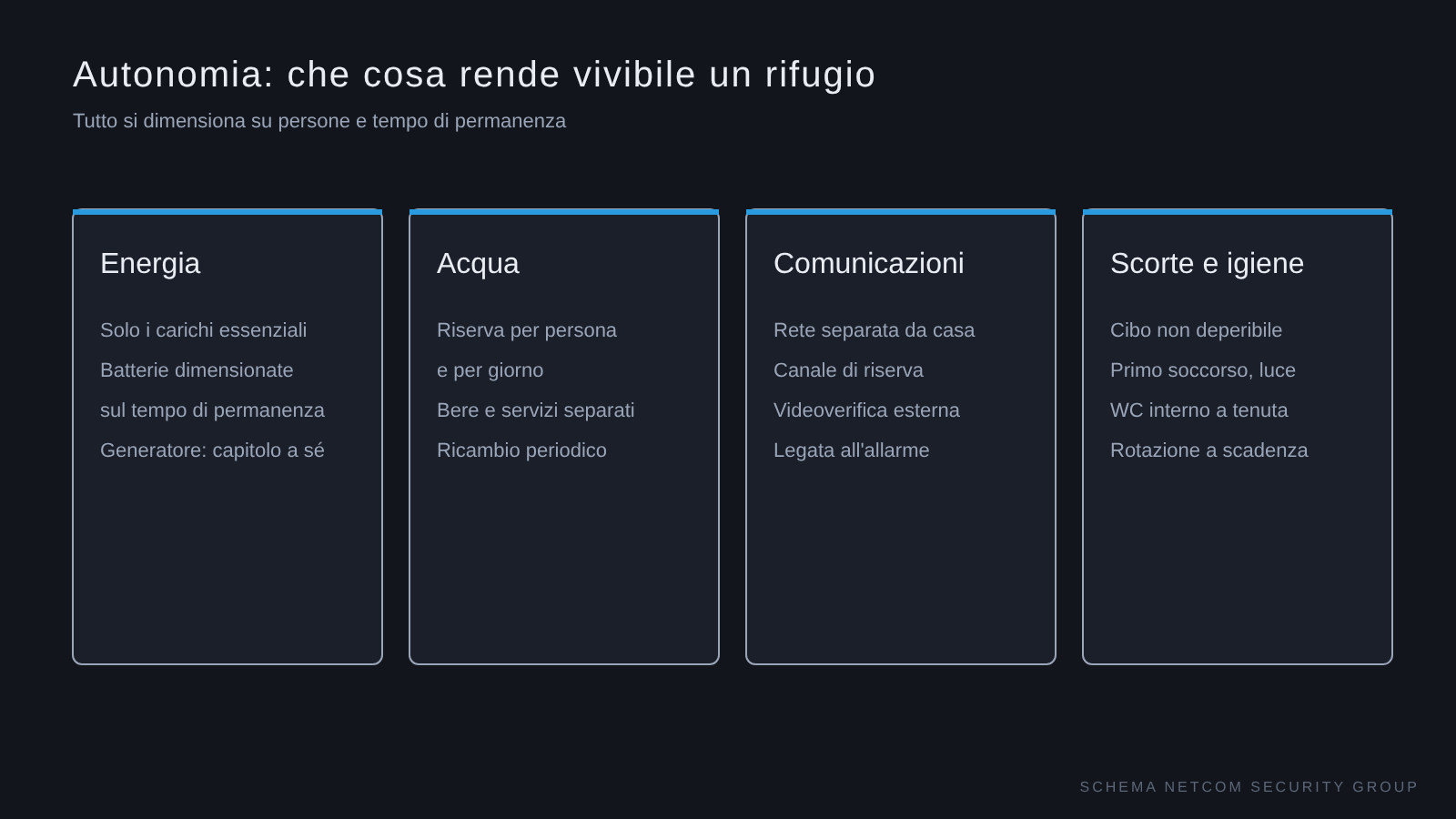
The supply inventory also falls within the confidentiality of the project: it reveals how many people the shelter accommodates and for how long. The overall picture of autonomy is described on the page about autonomy, energy, water and communications in a shelter.
Frequently asked questions
How many days of emergency food supplies should you keep?
The European Commission recommends at least 72 hours, Switzerland and Sweden about a week. In a private shelter the number of days is set in the design, starting from real needs.
Which foods should be stored in a shelter?
Foods with a long shelf life at room temperature that provide energy, need little water and can be eaten without cooking: tinned food, UHT milk, hard cheese, dried fruit and nuts, chocolate and rusks, as well as foods suitable for children and special diets.
How often should the supplies be checked?
We suggest two checks a year on fixed dates, with labels and a written inventory. Low-acid canned goods keep their quality for two to five years, high-acid ones for 12 to 18 months.
If you would like to define your shelter's autonomy starting from your family's needs, you can consult the service page NetCom Private Bunker for private bunkers and shelters and request a confidential consultation.
To assess a shelter on your property: Private bunkers and shelters · Preliminary shelter check · Who builds private bunkers in Italy · Bunker cost
Sources
- EU Preparedness Union Strategy to prevent and react to emerging threats and crises — European Commission, 26 March 2025.
- Kluger Rat – Notvorrat — Federal Office for National Economic Supply (FONES/BWL), Switzerland.
- Notvorrat — Federal Office for National Economic Supply (FONES/BWL), Switzerland.
- Access to food during a crisis — Swedish Civil Defence and Resilience Agency (MCF, formerly MSB), revised 30 September 2026.
- Home preparedness — Krisinformation.se, Sweden, updated 27 September 2026.
- Food — Ready.gov, FEMA.
- Shelf-Stable Food Safety — Food Safety and Inspection Service, United States Department of Agriculture (USDA).
- Date marking and food waste prevention — European Commission, DG Health and Food Safety.
- Proteggersi dall'avvelenamento da monossido di carbonio — Istituto superiore di sanità, EpiCentro.
- Power outages across Spain and Portugal affected millions. How to prepare for a major blackout — Associated Press (republished by News4JAX), 29 April 2025.