
In brief. When the power grid and the mobile network go down, the most reliable channel for receiving news is still an FM radio powered by batteries, a hand crank or the sun. To communicate outwards you need means that do not depend on the mobile network, but above all a contact plan agreed in advance: who calls whom, by what means, and where to meet if nobody answers. In an underground shelter, antennas and cable penetrations must be planned at the design stage.
What happens to the networks when the power fails
On 28 April 2025 a blackout left Spain and Portugal in the dark for many hours. The AFP news agency, in a report republished by The Local, described a country without internet or television, with patchy phone coverage and people gathered in the street, or in cars with the doors open, around transistor radios. In February 2026 Reporters sans frontières reconstructed the day at one of Spain's main broadcasters: generators kept running with diesel carried by hand in jerrycans up to the roof, studios cut to the minimum to save energy, batteries and portable radios sold out in the shops.
The episode had regulatory consequences. On 25 June 2026 the Spanish government announced that it will require operators to maintain mobile coverage for four hours if the power grid fails, with batteries that, once fully in force, must serve 75% of the population, starting from 50% in the first year. Intermediate installations will have to stay active for at least 12 hours, essential ones for at least 24. At the time of the announcement the royal decree was still going through approval, expected by the end of 2026.
What matters is the order of magnitude: even under the new Spanish rules, guaranteed mobile coverage without power is measured in hours, not days. Anyone designing a shelter with an autonomy of one or two weeks cannot rely on the mobile phone as the only channel.
Receiving: radio remains the basic channel
In Sweden public radio has a precise role in a crisis. The public portal Krisinformation, on its page updated in September 2026, explains that the public radio channel P4, with 25 local stations, is the country's emergency channel, and that the FM network keeps working when electricity, telephone and internet are down. To listen without power, a battery, hand-crank or solar radio is all you need. The same radio appears on the basic list of Ready.gov, the website of the US FEMA, and on the one that European Commissioner Hadja Lahbib presented in March 2025 with the strategy for 72 hours of self-sufficiency.
In an underground shelter there is an additional problem: the concrete and soil that protect the occupants also attenuate radio signals. A radio that picks up well in the kitchen may fall silent a few metres below ground. The solution is an external antenna connected by a cable that passes through the structure, and that penetration must be designed together with all the others, because every opening in the structure affects its sealing. Adding it after the work is finished is more expensive and less safe.
Transmitting: telephone, satellite, radio
As long as the mobile network holds, it pays to use it well. The joint guidance from the US FCC and FEMA is simple: short calls and only when necessary, text messages instead of calls, because they can get through even when calls fail, ten seconds' wait before redialling a number, screen brightness at minimum and apps closed to save battery. The same guidance reminds anyone charging a phone or listening to the radio in a car to beware of carbon monoxide, especially in enclosed spaces.
When the mobile network is gone, two routes remain. The first is a satellite link, with phones or terminals that need a view of the sky: in an underground shelter this means, once again, an external antenna and a cable planned in the design. The second is two-way radio, which covers different distances depending on the band and the equipment; some require a licence and all require a minimum of practice. In both cases the typical mistake is the same: buying the device, shutting it in a cupboard and discovering on the day it is needed that the battery is flat, the subscription has expired or nobody in the family knows how to use it.
The contact plan: the part you cannot buy
Equipment is of little use without a prior agreement on how to use it. The FCC suggests saving an emergency contact in every phone, preparing a group list and checking that family members and out-of-area contacts know how to send messages. A Swedish municipal booklet from 2024, designed to complement the national one, leaves space to note an element that is often overlooked: the agreed meeting places, in case family members cannot get in touch with each other.
An essential plan fits on a sheet of paper, kept in the shelter with a copy at home. It should state:
- who alerts whom, and in what order;
- a reference contact far from the affected area, who acts as a switchboard for everyone;
- one or two meeting points, with an agreed waiting time;
- the radio frequencies to listen to and the times at which to switch the equipment on to save energy.
One simple habit makes the plan genuinely useful: test it once or twice a year, with the same people who would have to use it. Families with domestic staff or children in other cities should include them.

NetCom's view
For NetCom, communications are part of the security project, not an accessory to be added. We start from the risk assessment and from concrete questions: whom the family must be able to talk to, for how many days, and from where. The answers guide the choice of equipment, which we coordinate with the qualified engineers responsible for structure, building services and ventilation, so that antennas and cable penetrations do not compromise the sealing of the shelter. Installation is entrusted to selected partner companies, supervised according to our protocols.
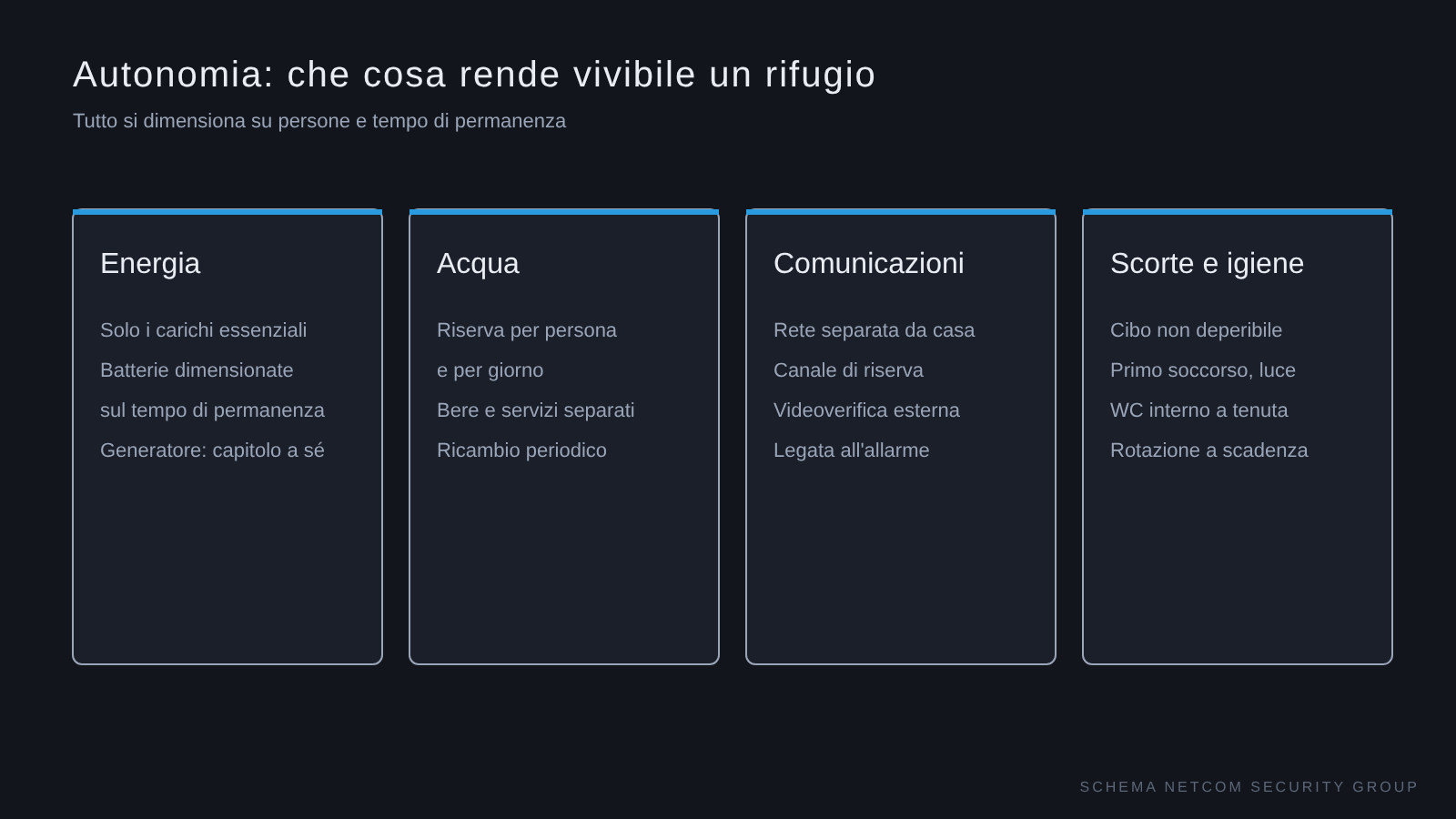
Finally, the contact plan contains sensitive information: who lives where, where the shelter is, how to reach it. We treat it with the same confidentiality as the rest of the project. The other components of autonomy are described on the page about autonomy, energy, water and communications in a shelter.
Frequently asked questions
Which means of communication works when the internet and mobile network go down?
For receiving information, a battery, hand-crank or solar FM radio: according to the Swedish authorities, the FM network keeps working when electricity, telephone and internet are down. For transmitting, you need satellite equipment or two-way radios.
Does a radio work inside an underground bunker?
Often poorly, because soil and concrete attenuate the signal. That is why the antenna must be taken outside, with a cable penetration planned in the design of the structure.
What should a family contact plan contain?
Who alerts whom, a reference contact outside the area, one or two meeting points with waiting times, and the radio frequencies to listen to. It should be written on paper and tested once or twice a year.
To design a shelter's communications together with the rest of the security system, you can start from the service page NetCom Private Bunker for private bunkers and shelters and request a confidential consultation.
To assess a shelter on your property: Private bunkers and shelters · Preliminary shelter check · Who builds private bunkers in Italy · Bunker cost
Sources
- Candles and radios in demand in Spain as blackout lessons sink in — AFP (republished by The Local Spain), 30 April 2025.
- Radios never go silent: the day Spain clung to the airwaves — Reporters sans frontières, 13 February 2026.
- Óscar López anuncia que el Gobierno obligará a mantener la cobertura móvil 4 horas en caso de apagón — Spanish government, La Moncloa, 25 June 2026.
- Swedish Radio's emergency broadcasting responsibility — Krisinformation.se, Sweden, updated 26 September 2026.
- FCC/FEMA Tips for Communicating During an Emergency — Federal Communications Commission and FEMA, revised 23 October 2019.
- Emergency Supply List — Ready.gov, FEMA.
- EU tells the public to hold 72 hours of emergency supplies — Reuters (republished by Cyprus Mail), 26 March 2025.
- In case of crisis or war (local version) — Linköping Municipality, Sweden, autumn 2024.