In brief. In a shelter, power is needed first and foremost for ventilation, lighting and communications; comfort comes later. A combustion generator produces carbon monoxide, a gas that is invisible and odourless: it must never be run in an enclosed room, nor in a garage, nor near doors and windows. Batteries, mains supply and any generator outdoors are chosen and positioned in a design signed off by qualified professionals.
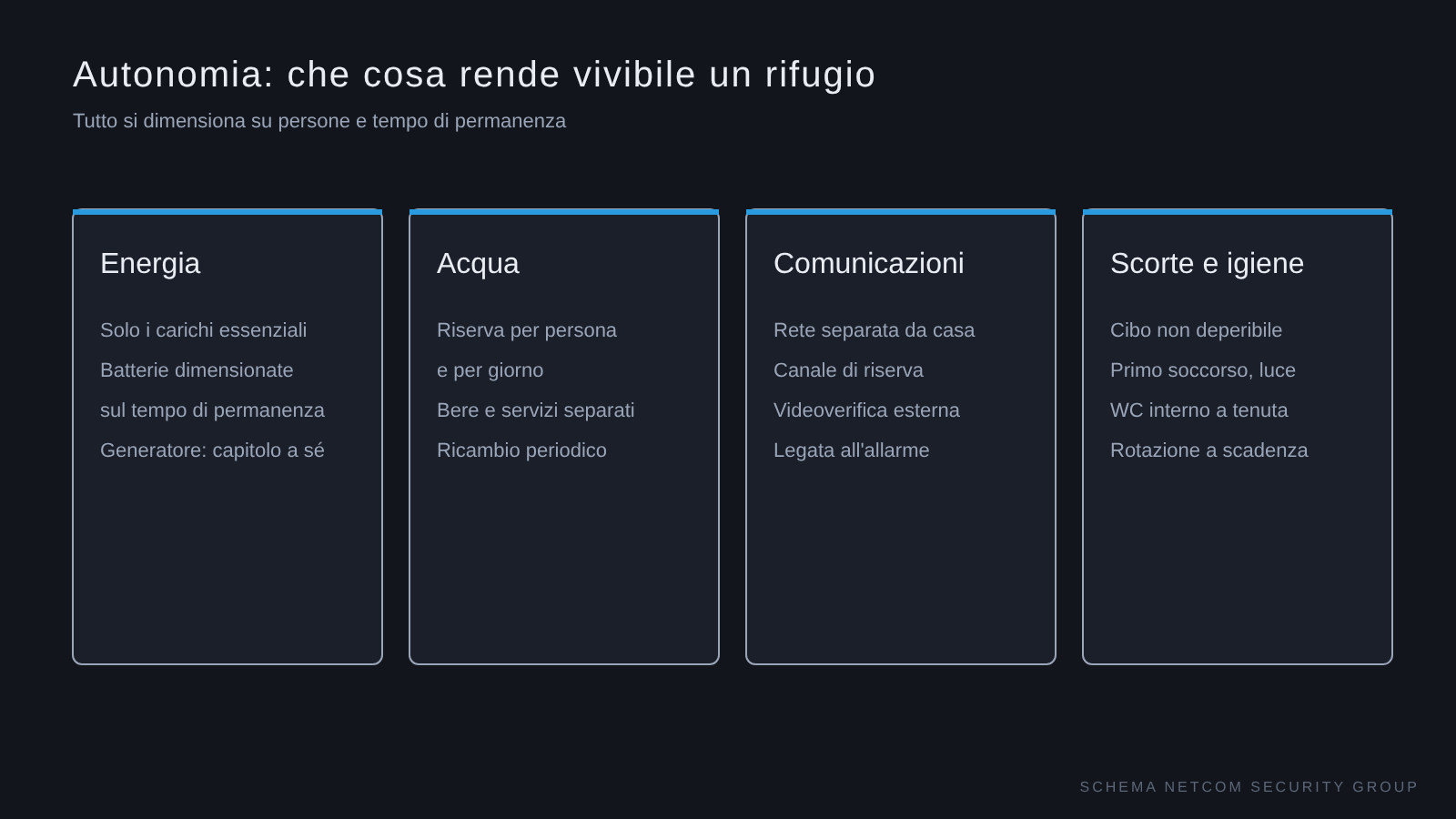
What a shelter really needs to power
The right question is not how much power to install, but which functions must stay active and for how long. In order of importance come ventilation with air filtration, which keeps people alive; lighting, without which even simple tasks become risky; communications, to receive news and call for help; and any medical devices. Air conditioning, household appliances and entertainment come afterwards, and they are often what drives up the requirement.
Switzerland offers a useful criterion. The technical specification from the Federal Office for Civil Protection for small shelter ventilation units, in its edition of 1 October 2026, provides for a hand-crank drive designed for at least 700 hours of operation. Emergency operation is defined as manual ventilation through the gas filter when the outside air is contaminated. In other words, the vital function must continue even without power: first you secure what is needed to breathe, then the rest. Air is covered in more depth on the page on air, ventilation and filtration in shelters.
Carbon monoxide: the risk you cannot sense
Petrol or diesel engines, gas burners, braziers: anything that burns fuel produces carbon monoxide when combustion is incomplete. The World Health Organization's 2010 guidelines on indoor air quality explain the mechanism: the gas binds to haemoglobin, forming carboxyhaemoglobin, which reduces the blood's ability to carry oxygen to the tissues. At low levels it causes headaches, tiredness and effects on concentration; at high levels it can be fatal.
The Istituto Superiore di Sanità (ISS, Italy's National Institute of Health), on its emergencies page, describes generators as very dangerous in enclosed spaces such as houses, garages or campervans, and adds a detail that dispels a widespread habit: the danger remains even with doors and windows open. The ISS lists the symptoms, including headache, dizziness, weakness, nausea and confusion, and points out that people who are asleep can die before showing symptoms. The US Centers for Disease Control and Prevention, on a page updated in August 2026, ask for generators to be kept outdoors and at least 20 feet, about six metres, from doors, windows and air vents.
For a shelter the consequence is direct. A room designed to keep outside air out is, by definition, the worst place to accumulate exhaust gases. And an air intake drawing in near the point where an engine exhausts risks bringing inside exactly what you wanted to keep out.
What blackouts teach us
The documented cases recur with a regularity that ought to be warning enough. During the winter storm of February 2021 in Texas, US public radio NPR reported at least 300 cases of poisoning and two deaths in Harris County alone. The authorities attributed most cases to improper heat sources: barbecues, generators and car engines run indoors. The same report noted that misuse of generators had caused around 900 deaths in the United States between 2005 and 2017.
In Ukraine, where blackouts caused by attacks on the grid have become part of daily life, the Ukrinform agency reported that over the weekend of 7 and 8 February 2026 alone the State Emergency Service recorded nine cases in eight regions, with four deaths and 25 injured, including 15 children. In five cases the cause was a generator placed inside a building or too close to windows.
Batteries: silent, but they must be designed
Electric storage batteries produce no exhaust gases and make no noise, two valuable qualities in an enclosed space. That does not make them something to buy and plug in. Capacity, charging system, electrical protection and ventilation of the room housing them depend on the technology chosen and the applicable standards, and must be defined by an electrical systems designer.
Advice for households remains useful as a starting point. After the major blackout that hit Spain and Portugal on 28 April 2025, the Associated Press gathered the essential tips: battery-powered or hand-crank radio with spare batteries, battery lights to be used sparingly, charged power banks, caution with candles and gas lanterns because of the risk of fire and carbon monoxide. On generators, the same article reminded readers never to use them indoors and never to connect them to the home's electrical system. This advice applies doubly to a shelter.
Generator or not: the criteria for deciding
A generator can make sense when the required autonomy exceeds what batteries can reasonably cover. The decision, however, comes after some precise answers. Where do the fumes discharge, and how far from the air intakes of the shelter and the house? Where is the fuel stored, and in what quantity? Who looks after its maintenance and periodic testing? What happens to the ventilation if the generator stops?
Whatever the choice, the CDC recommends a battery-powered or battery-backup carbon monoxide detector in every home, to be checked when the clocks change. On the same page it states that in the United States over 400 people die every year from poisoning not related to fires, with more than 100,000 emergency department visits. In a shelter, a detector independent of the mains supply is, in our view, the minimum, not an optional extra.
The typical mistake is thinking a little air is enough: running the engine in the entrance corridor with the door open seems a reasonable compromise and is exactly what the ISS advises against. The second is sizing the system for comfort instead of for vital functions.
NetCom's view
NetCom approaches power starting from the risk assessment: what must work, for how many people, for how many days. For power, the starting point is the real need, and this generally leads to a simpler and safer system. The electrical design, the choice between storage and generation, and the position of exhausts and air intakes are the responsibility of qualified professionals, whom we coordinate together with the structural and ventilation designers. Installation is entrusted to selected partner companies supervised under our protocols.
The overall picture, linking power, water and communications, is described on the page on energy autonomy, water and communications in a shelter.
Frequently asked questions
Can a generator be kept inside a bunker?
A combustion engine running in an enclosed room produces carbon monoxide, an odourless and potentially lethal gas. The ISS advises against indoor use even with doors and windows open. Any generation must be designed by qualified professionals with separate exhausts and air intakes.
Which functions should a shelter's power supply serve first?
Air ventilation and filtration, lighting, communications and any medical devices. In Switzerland small shelter ventilation units must also be able to run by hand crank.
Does a shelter need a carbon monoxide detector?
Yes. The CDC recommends a battery-powered or battery-backup detector in the home; in a shelter, where outside air enters only through the system, it is a minimum safeguard.
To plan a shelter's power supply starting from your family's real needs, you can consult the service page for NetCom Private Bunker, private bunkers and shelters and request a confidential conversation.
To assess a shelter on your property: Private bunkers and shelters · Preliminary shelter check · Who builds private bunkers in Italy · Bunker cost
Sources
- WHO Guidelines for Indoor Air Quality: Selected Pollutants — Carbon monoxide — World Health Organization, 2010.
- Protecting yourself from carbon monoxide poisoning — Istituto Superiore di Sanità, EpiCentro.
- Avoiding Carbon Monoxide Poisoning — Centers for Disease Control and Prevention, 26 August 2026.
- Carbon Monoxide Detectors — Centers for Disease Control and Prevention.
- Technisches Pflichtenheft TPH-11 für Kleinbelüftungsgeräte VA 40, 75, 150 und 300 — Federal Office for Civil Protection (BABS/FOCP), 1 October 2026.
- 'A Disaster Within A Disaster': Carbon Monoxide Poisoning Cases Are Surging In Texas — NPR, 18 February 2021.
- Carbon monoxide poisoning kills four people in Ukraine over weekend, 15 children among injured — Ukrinform, 9 February 2026.
- Power outages across Spain and Portugal affected millions. How to prepare for a major blackout — Associated Press (republished by News4JAX), 29 April 2025.