In brief. For drinking and preparing food you need about 3 litres of water per person per day; adding basic hygiene and cooking, the World Health Organization gives a total of between 7.5 and 15 litres. A shelter's supply is calculated by multiplying the number of people by the chosen days of autonomy; it is kept in a dark, cool place, renewed at fixed intervals and backed up by at least one method of making other water safe to drink.
How much water you need: the authorities' figures
The official figures seem to differ, but they answer different questions. The one most often cited in international manuals comes from a technical note prepared for the WHO in 2013: for survival alone, that is drinking and taking food, you need 2.5 to 3 litres per person per day. Basic hygiene adds 2 to 6 litres, cooking 3 to 6. The total ranges from 7.5 to 15 litres, varying with climate and the individual.
National agencies translate these values into household supplies. Switzerland, through the Federal Office for National Economic Supply, asks for at least 9 litres per person, the equivalent of six one-and-a-half-litre bottles, and specifies that this covers three days of drinking and cooking, not washing or flushing the toilet. In Sweden the public portal Krisinformation, updated in September 2026, speaks of 3 to 5 litres per person per day and asks people to prepare for at least a week. In the United States, Ready.gov, the FEMA website, recommends one gallon per person per day, just under 3.8 litres, for drinking and hygiene, warning that children, nursing mothers, sick people and those living in hot climates may need more.
| Source | Quantity given | Time frame |
|---|---|---|
| WHO (technical note, 2013) | 2.5-3 l for drinking and eating; 7.5-15 l in total | Per day |
| Switzerland, national economic supply | At least 9 l per person | 3 days, drinking and cooking only |
| Sweden, Krisinformation (2026) | 3-5 l per person per day | At least one week |
| United States, Ready.gov | About 3.8 l per person per day | Several days |
| European Commission (March 2025) | Essential supplies, water included | At least 72 hours |
The European reference is recent. On 26 March 2025 the Commission presented its Preparedness Union Strategy, which encourages citizens to keep essential supplies for at least 72 hours. Reuters reported that Commissioner Hadja Lahbib, in a video, listed what is needed to get through 72 hours of crisis: food and water, a torch, a power bank, a radio, cash and medicines.
From the household kit to the shelter: how the calculation changes
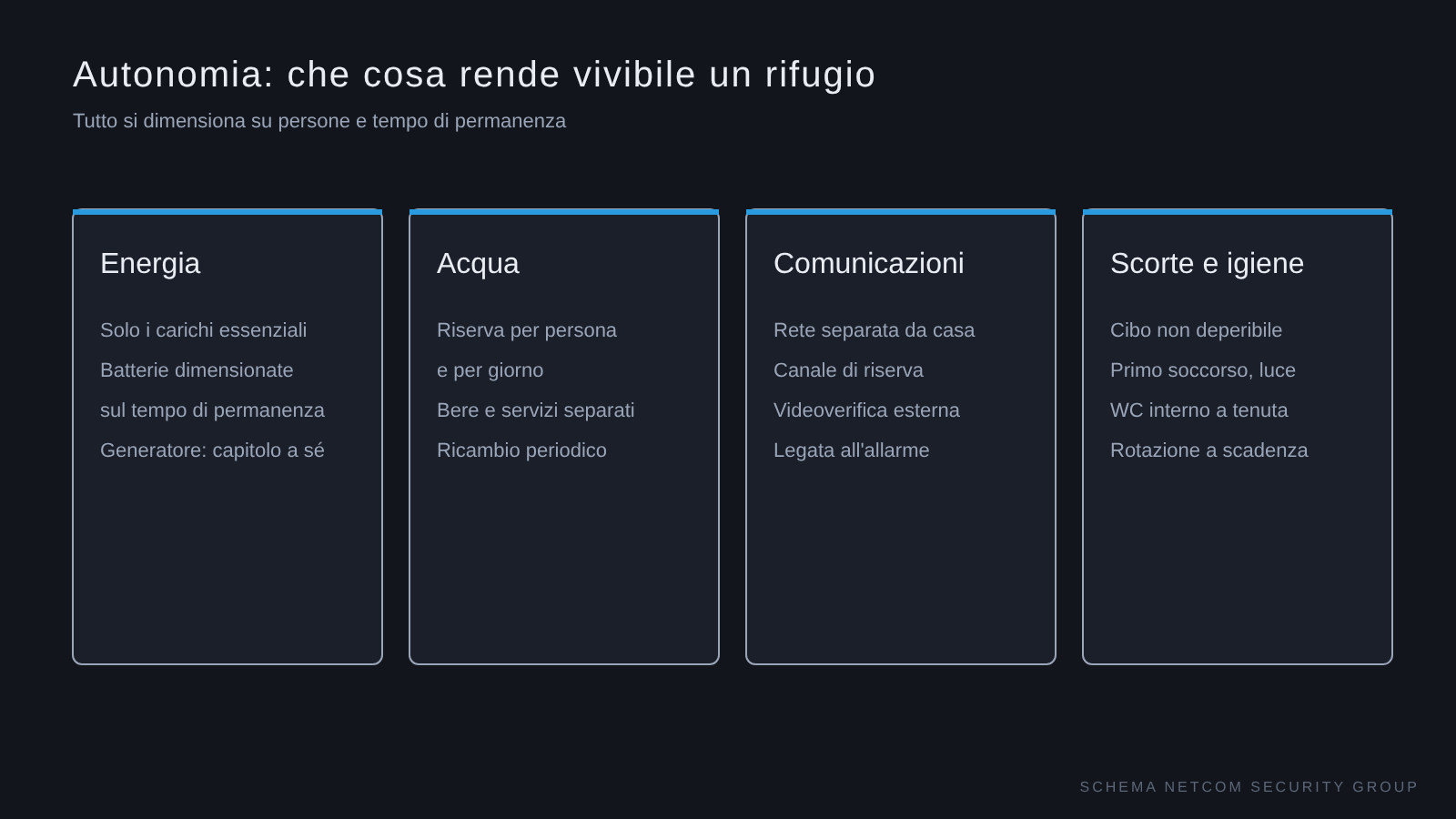
The European 72 hours are a minimum threshold designed for all households. A private shelter is often built to cover longer periods, and here the numbers grow quickly. Take a family of four and fourteen days of autonomy. At 3 litres each, for drinking and cooking only, you need 168 litres. With the WHO minimum of 7.5 litres, which includes hygiene and cooking, you reach 420 litres; with the upper value of 15 litres, 840 litres.
A litre of water weighs about a kilo. Almost a tonne of supplies takes up space and loads a floor slab: the placement of tanks and shelving must therefore be checked by a qualified engineer, not decided once the design is finished. Even before that, it is worth asking how many days are really needed. For autonomy too, the rule of starting from the real need avoids unnecessary volumes and leaves resources for what matters.
Bottles or tank
Commercial bottles are the simplest solution: Ready.gov advises leaving them sealed in their original packaging, in a cool, dark place. Those who fill their own containers must use food-grade ones, wash and disinfect them, and replace the water every six months. Krisinformation suggests checking the supply once or twice a year and assessing it by sight, smell and taste too; it also proposes freezing water in PET bottles not filled to the brim, which serve first as ice packs and then as a reserve.
A fixed tank makes sense when volumes are large, but it brings with it cleaning, inspection access and scheduled replacement. Our criterion is not to entrust all the water to a single container: if that one becomes contaminated, the entire supply is lost. A share in sealed bottles, kept separate from the tank, is an inexpensive safeguard against this mistake.
Making water safe to drink when the supply runs short
A supply runs out. That is why at least one backup method is needed, known and tested before it is required. The clearest reference is the page of the US Centers for Disease Control and Prevention, updated in September 2024.
Boiling remains the most effective method against germs. If the water is cloudy, let it settle or filter it, then bring it to a full boil for one minute; above roughly 2,000 metres of altitude this becomes three minutes. For chemical disinfection the CDC recommends unscented household bleach: with products containing between 5 and 9% sodium hypochlorite, 2 drops per litre are enough; stir and wait at least 30 minutes, doubling the dose if the water is cloudy or very cold. In Italy the concentrations on sale vary, so the label must be read beforehand, not during the emergency.
Two limitations deserve attention. Chlorine or iodine tablets do not eliminate Cryptosporidium, a resistant parasite, whereas chlorine dioxide tablets can do so if used correctly. Portable filters, on the other hand, do not retain viruses: for bacteria an absolute pore size of 0.3 microns or less is needed, for parasites 1 micron or less. The CDC recommends following filtration with chemical disinfection.
The most common mistakes
The first is counting only drinking water. The Swiss guidance itself excludes washing and toilets, which cannot be neglected in a room closed for days. The second is forgetting rotation: a supply filled at commissioning and never touched again is, after a few years, an unknown quantity. The third is having only one purification method, perhaps never tried. The fourth concerns people: a newborn, an elderly person on medication or a very hot summer change the requirement, as FEMA itself points out.

NetCom's view
In our work, water enters the design after the risk assessment, not before. We establish with the client how many people, how many days and what special needs, then translate the answer into litres, weights and spaces. Tanks, systems and structural loads are sized by qualified professionals, coordinated by NetCom; installation is entrusted to selected partner companies supervised under our protocols. For overall autonomy, see the page on autonomy, energy, water and communications in a shelter.
Then there is confidentiality. The quantities stored and where they are kept say a great deal about a shelter and those who use it: they stay in the design documents, not in conversations with suppliers.
Frequently asked questions
How much water per person does a shelter need?
About 3 litres a day for drinking and cooking; adding basic hygiene and cooking, the WHO gives a total of between 7.5 and 15 litres. The supply is obtained by multiplying by the number of people and the days of autonomy.
How often should the stored water be changed?
Bottled water is kept sealed until its expiry date. Water in your own containers, according to Ready.gov, should be replaced every six months; in Sweden a check once or twice a year is recommended.
How do you make water safe to drink in an emergency?
By boiling it for one minute, three above roughly 2,000 metres, or with unscented bleach dosed according to its concentration. Portable filters do not retain viruses and should be followed by chemical disinfection.
If you are considering how much autonomy to give a shelter for your home, you can start from the service page for NetCom Private Bunker, private bunkers and shelters and request an initial confidential conversation.
To assess a shelter on your property: Private bunkers and shelters · Preliminary shelter check · Who builds private bunkers in Italy · Bunker cost
Sources
- Quelle est la quantité d'eau nécessaire en situation d'urgence ? — World Health Organization / WEDC, Technical notes on drinking-water, sanitation and hygiene in emergencies, no. 9, July 2013.
- Kluger Rat – Notvorrat — Federal Office for National Economic Supply (FONES/BWL), Switzerland.
- Home preparedness — Krisinformation.se, Sweden, updated on 27 September 2026.
- Water — Ready.gov, FEMA.
- How to Make Water Safe in an Emergency — Centers for Disease Control and Prevention, 19 September 2024.
- EU Preparedness Union Strategy to prevent and react to emerging threats and crises — European Commission, 26 March 2025.
- EU tells the public to hold 72 hours of emergency supplies — Reuters (republished by Cyprus Mail), 26 March 2025.