In brief. In a shelter that stays sealed for days, the toilet is a health issue before it is a matter of comfort. If the drainage does not work you need a dry toilet or one with bags, absorbent material, disinfectant, a place to wash your hands and sealed containers for waste. The design must allow for drainage, ventilation, space and waste volume for all the days of autonomy that have been set.
Why the toilet is a health issue
In its fact sheet on sanitation, updated in March 2024, the World Health Organization points out that inadequate sanitation is linked to the transmission of diarrhoeal diseases such as cholera and dysentery. The settings described by the WHO are mainly those of low-income countries, but the mechanism applies everywhere: when excreta are not contained and hands are not washed, infections pass from one person to another. In a room of a few square metres, with the same people for days, this transmission is faster.
The US Centers for Disease Control and Prevention, on their page on sanitation in emergency response, set two priorities: contain the waste and prevent it from ending up in the open. They also recommend a handwashing point next to every toilet, whatever solution is adopted.
How Switzerland solves it
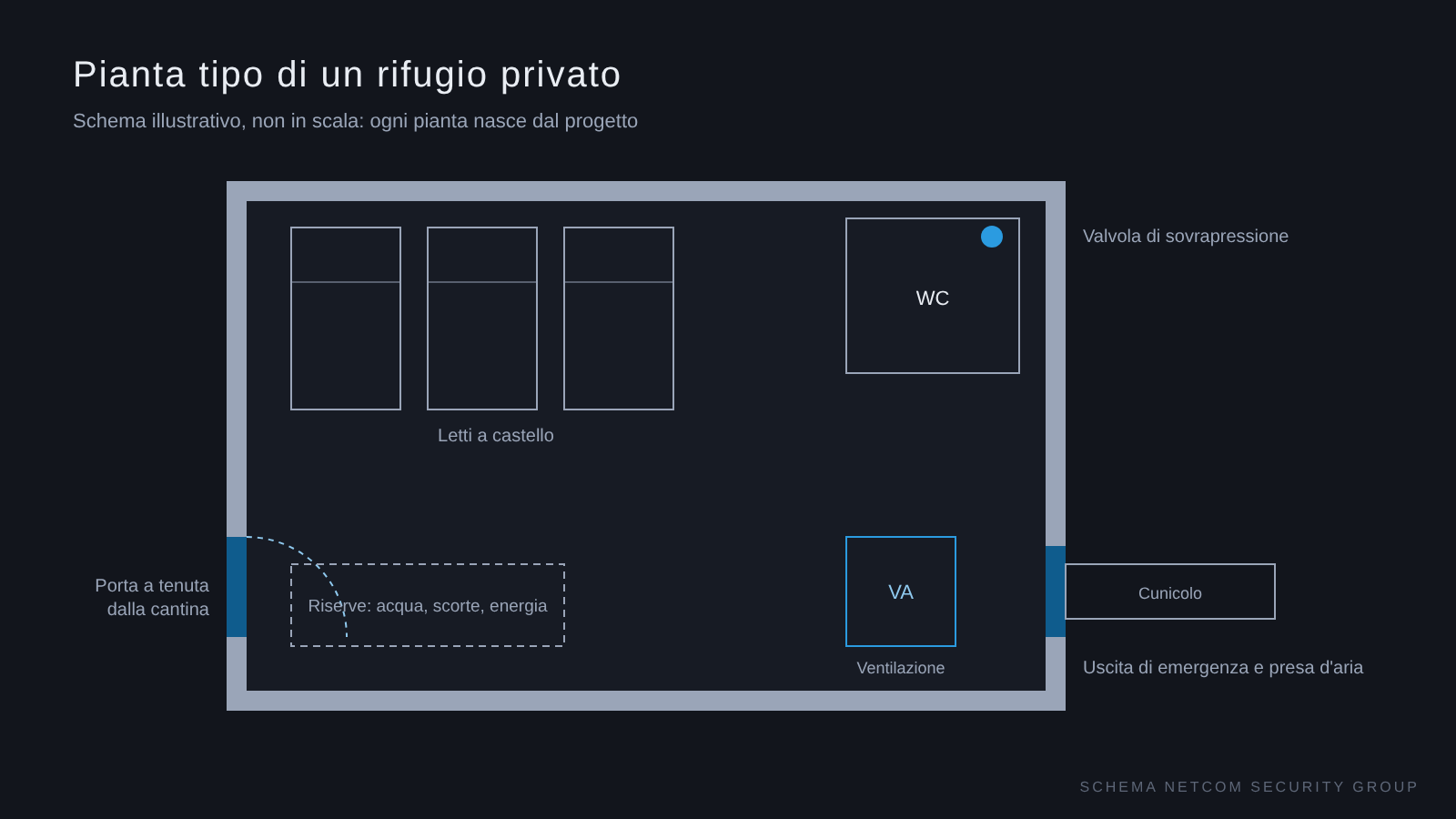
The Swiss shelter system treats toilets as part of the mandatory equipment. The page of the Canton of Schwyz on shelter equipment lists three items required by federal regulations: three-tier bunk beds, toilet cubicles and dry toilets. The latter come in three sizes: one box for a maximum of 10 people, one for a maximum of 20, three boxes for a maximum of 30. All components must be approved by the federal authority.
For humanitarian emergencies the CDC sets an initial threshold of one latrine per 50 people, with the aim of reaching the minimum set by the international Sphere standards: one per 20. For a family these numbers are far off, but the principle is the same: the toilet is sized on the number of people and the duration, not improvised.
When the drainage does not work
A shelter connected to the sewer seems to solve everything. But if the room is lower than the sewer main, drainage depends on a pump and therefore on electricity; and in some scenarios the system may be out of action or have to be shut off. That is why an independent solution is always needed.
The simplest is described by the North Carolina Department of Health in a guide from October 2024: a bucket of about 19 litres, possibly with a seat, lined with a double bag. After use, absorbent material such as cat litter, peat or lime is added, which absorbs liquids and reduces odours. Used bags are closed and placed in a rubbish bin, away from children and animals. Ready.gov, the FEMA website, includes moist towelettes, rubbish bags and plastic ties in the basic kit precisely for personal hygiene. A Swedish municipal booklet from 2024 gives similar advice: line the WC with a strong bag and then transfer it to a bin or a bucket with a lid.
A calculation helps to grasp the volumes. For bag latrines used in emergencies, the CDC estimates about one bag per person per day. For four people and fourteen days that means at least 56 full bags, plus the absorbent and the containers to store them. It is a volume that has to be planned in the shelter's layout, not crammed into a corner at the last minute.
The typical mistake
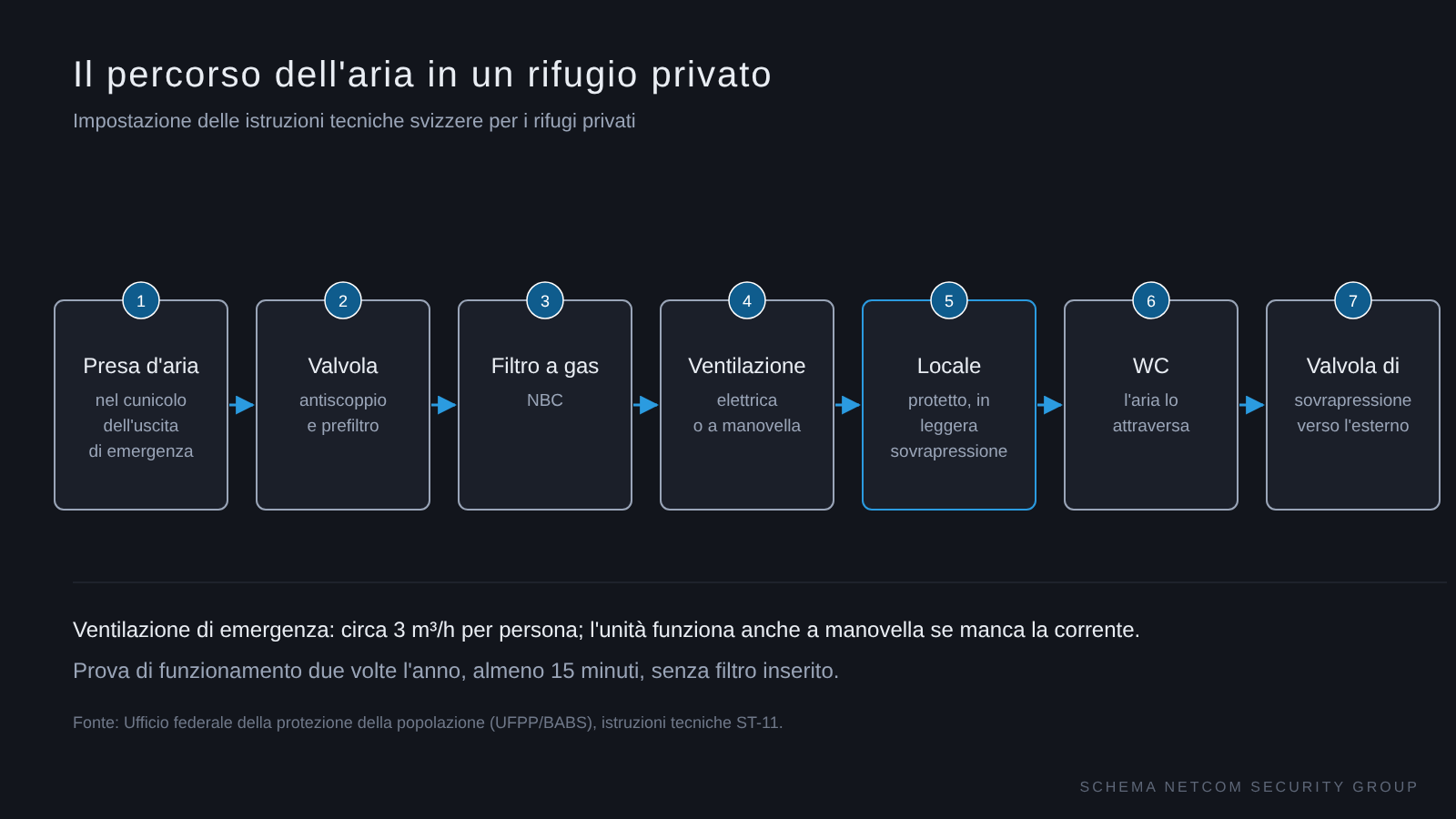
The recurring mistake is to design a bathroom "like at home" and nothing else. It works as long as water, drainage and power work. The second mistake is forgetting the air: in a sealed room, the odours and humidity of a toilet weigh on the ventilation, which must be sized for this too. The subject is explored on the page about air, ventilation and filtration in shelters.
Personal hygiene with little water
The CDC guidance on hygiene in emergencies, updated in August 2024, starts with hands: soap and water for at least 20 seconds, at key moments. When water is lacking, a gel with at least 60% alcohol is an acceptable substitute, with some limits: it does not remove all germs, it does not remove chemicals and it works poorly on visibly dirty or greasy hands. Only safe water should be used for brushing teeth. Wounds should be cleaned with soap and water and covered with a waterproof plaster.
Water consumption for hygiene must be included in the supply calculation. The technical note prepared for the WHO in 2013 estimates between 2 and 6 litres per person per day for basic hygiene, in addition to what is needed for drinking and cooking. Wipes, gel, intimate hygiene and baby products reduce the need for water, but they too must be stocked in sufficient quantities.
Waste: the volume nobody calculates
Besides toilet waste, packaging, food scraps and sanitary materials accumulate in a shelter. In a warm, enclosed environment, organic waste soon produces bad odours. Airtight containers, separated by type, and a dedicated area away from the spaces where people sleep and eat are the basics. It also pays to reduce waste at source, by choosing supplies with little packaging and single-portion packs.
The Ukrainian experience shows what happens when these aspects are neglected. In June 2023 the AFP news agency described some shelters in Kyiv with broken toilets, rusty water tanks, mouldy walls and residents forced to clean up excrement regularly; some said it might be better to stay at home. A few days earlier the Associated Press reported that, out of more than 4,800 shelters inspected in Ukraine, 252 were locked and 893 unusable. A shelter that nobody wants to enter protects nobody.
NetCom's view
For NetCom, toilets and waste are part of the security project from the very first assessment: how many people, how many days, what particular needs, such as elderly people, young children or people on medical treatment. Drainage, pumps, ventilation and spaces are designed by qualified engineers, whom we coordinate so that the solutions are consistent with one another; installation is entrusted to selected partner companies, supervised according to our protocols. Here too the starting point is real need, not the pursuit of the maximum. The other components of autonomy are described on the page about autonomy, energy, water and communications in a shelter.
Frequently asked questions
What kind of toilet does a bunker need if there is no water?
A dry toilet or a bucket with a double bag and absorbent material such as cat litter, peat or lime, plus disinfectant and lidded containers for used bags. In Switzerland, mandatory shelters have approved dry toilets.
How many bags are needed for an emergency toilet?
The CDC estimates about one bag per person per day. For four people and fourteen days you need at least 56, plus the absorbent and the space to store them sealed.
How do you wash your hands in a shelter with little water?
With soap and water for at least 20 seconds whenever possible; otherwise with a gel containing at least 60% alcohol, which however works poorly on visibly dirty hands and does not remove all germs.
To design toilets, drainage and waste management together with the rest of the shelter, you can start from the service page NetCom Private Bunker for private bunkers and shelters and request a confidential consultation.
To assess a shelter on your property: Private bunkers and shelters · Preliminary shelter check · Who builds private bunkers in Italy · Bunker cost
Sources
- Sanitation — World Health Organization, 22 March 2024.
- Potential Sanitation Solutions During an Emergency Response — Centers for Disease Control and Prevention.
- Guidelines for Personal Hygiene During an Emergency — Centers for Disease Control and Prevention, 5 August 2024.
- Schutzraumausrüstung — Canton of Schwyz, Office for Military, Fire and Civil Protection.
- Toilet Use During an Emergency — North Carolina Department of Health and Human Services, October 2024.
- Emergency Supply List — Ready.gov, FEMA.
- In case of crisis or war (local version) — Linköping Municipality, Sweden, autumn 2024.
- Quelle est la quantité d'eau nécessaire en situation d'urgence ? — World Health Organization / WEDC, technical note no. 9, July 2013.
- 'Better stay home': Kyiv's grim bomb shelters deter residents — AFP (republished by Ahram Online), 16 June 2023.
- Ukraine says inspections found nearly a quarter of its air-raid shelters locked or unusable — Associated Press (republished by News4JAX), 3 June 2023.